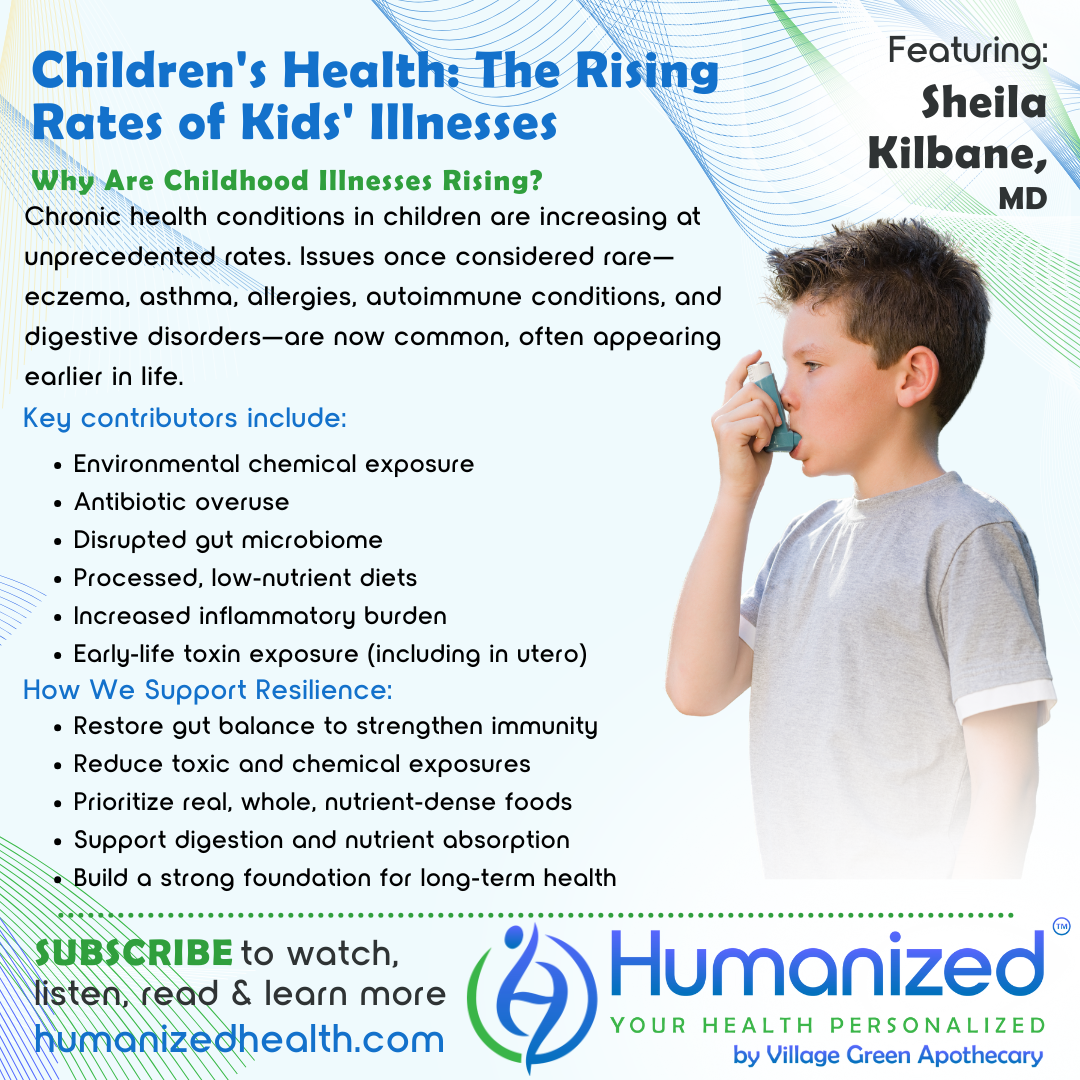
Children’s Health: The Rising Rates of Kids’ Illnesses
Featuring
Sheila Kilbane, MD


WATCH
LISTEN
READ
David Stouder: Welcome everyone to the Humanized Health Podcast, and it’s all about personalizing your health. And before we get started, I wanna let you know that we’ve got lots of great free podcasts here at the Humanized Health website, and you can get transcriptions, video, audio, and we’ve just been building a great library of some of the real great thought leaders in our industry. And, please listen because you’re gonna learn a lot and you’re gonna learn a lot today. And I asked Dr. Sheila Kilbane to be on the program today because, I mean, I’ve noticed just people coming into the store, but I hear more and more in the news how sick our children are.
How, chronic diseases are just, they seem to be on the rise and, that seems sensible to me. Now, sometimes the media hypes things up, so we don’t always know what to believe. But I wanted to bring on, Dr. Kilbane is a integrative pediatrician, specializes in allergies, eczema, asthma, but she treats children and, being integrative, she relies a lot on nutrition and the food that they eat. And so I kinda wanted to ask Dr. Kilbane about this, and I wanna read you a little something about her from her website. This is a quote.
“Medical school trained me very well to recognize the symptoms of pediatric illnesses and to treat those symptoms. I could easily manage eczema, ear infections, and constipation with daily medications, but the more frequently kids return to my office, unhealed, after a prescription or procedure, the more frustrated everyone became, including me. After fellowship and integrative medicine in two decades of pediatric practice, I developed a method that could prevent or even reverse the common childhood illnesses that keep kids out of school, off the playground, and in a series of doctors’ offices.”
God bless you for that. I just have to say, because, gosh, if we can get our kids on the right track… So, do you see this trend or is the, in general, is the health of our children getting worse?
Sheila Kilbane: Yes, and it’s because in our practice we do integrative functional medicine. We see the kids who are, you know, going to the pediatrician and the specialist, and they’re doing everything conventional medicine is recommending, but they’re still struggling.
And it might be eczema, asthma, allergies, and all the other host of autoimmune conditions, right? Younger and younger, we’re seeing kids with inflammatory bowel disease like ulcerative colitis or Crohn’s disease. And the other big thing we’re seeing, right, are also these food allergies and food sensitivities and it’s these kids, younger and younger.
And when you really start to dig into this, and we were talking about this before we started today, I just, I recently did a TED Talk. It was a TEDx Nashville, and what the organizer wanted me to talk on was: What are these increasing illnesses? Especially eczema, because we see a lot of kids with eczema and what are these ink rise in illnesses trying to tell us?
And so we took it because eczema is such a, you know, it’s, it’s good to use with a talk because when you look at before and after pictures, it’s just an easy way to see things versus, you know, with asthma, when a child is improving, you can’t see a picture of their lungs and say, oh, this is what it looks like.
So, with eczema in particular, first, let me give you the 50,000 foot view. Kids, today, it’s about one in two kids, has a chronic illness, right?
David Stouder: Oh, my God.
Sheila Kilbane: 30 years ago, 40 years ago it was more like one in 15. And so, when you look at that, then we take a, microscope it down to eczema. So in the 1940s eczema, the prevalence of eczema, it was about 5%.
Now it’s about 20% and even higher in certain areas of the country, right. That’s a significant, we’re also talking about stats before this, significant increase. Yeah. In a short period of time. And so what happened is, in the forties, several things started to happen. It was around the end of World War II, and we began putting chemicals into our environment, into our food, into our cleaning products, our beauty products, and we weren’t really studying the health impacts of these chemicals. And the EPA, I think it was around the seventies, maybe the late seventies, early eighties, the EPA was required to keep a list of the chemicals that we were putting in the environment.
And there is a current list of over 86,000 chemicals that we’ve put into our environment. And some of them have been studied, but many, many of them have not been studied for their health implications. So we have that. The other thing that happened toward the end of World War, war II is the widespread use of antibiotics, right? And antibiotics save millions and millions of lives each year. So if you’re listening and you need an antibiotic, absolutely take it. What we need to be cognizant of, though, is that the antibiotic not only kills the bad bacteria in the ears, the gut, the lungs, but it also kills the beneficial bacteria that are in the gut and other places.
And we’ll talk about the microbiome, but what’s happening with all of these chemicals and antibiotics is that we’ve got trillions of bacteria in our, in our gut, on our skin, in our mouth, in our nasal passages, right? It’s the, microbiome. And if you think about these, think of the, those microorganisms, kind of like we’re like rainforests, like these little mini ecosystems teaming with these microorganisms.
What feeds and helps sustain those microorganisms are healthy food, right? Fiber, nuts, seeds, vegetables, fruits, and the things that harm this microbiome are chemicals, antibiotics, artificial dyes and colors, right? All of this stuff that we’re putting in our bodies and on our bodies. And we have to have a balance ’cause we can’t live in a vacuum, but we’ve upset the apple cart so much. And when you impact the microbiome…. The microbiome plays a significant role in our overall health, right? 70% of our immune system happens in the gut, and we’ve just, shifted our, microbiome and this is, at least in my educated opinion and in practicing peds over the last 20 years, this is what I think is happening.
And I wanna pause for a minute, I’ll go on about this, but I wanna hear any thoughts and questions that you have.
David Stouder: Well, I think you’re spot on and it ties in with, I hear some people talking about… what was interesting was, I’ll share this with you:
I met a fellow who wrote a book and he had an interesting rhetorical question. He said, “If every cell in your body worked perfectly a hundred percent of the time, which it wouldn’t, but if it did, could you be sick?” And the answer was kind of no. So his point was, every disease is cell malfunction. Whether it’s something serious or, and then why would a cell malfunction?
Well, there’s pretty much only two reasons. Not enough nutrition and or too many toxins. And so the cure, if you will, for everything is more nutrition, less toxins. And what you said about, I didn’t know it was 86,000 chemicals, and to the extent that any of them are studied, they’re not studied together.
And they’re not studied for decades. And, I think the impact on a forming child could be a lot different than a fully, you know, adult and on and on. So I think the food supply, unless you’re making an effort, is really degraded and the amount of environmental toxins and it’s really showing up in our children.
I think it’s showing up in everybody, but I think, it used to take us 30, 40 years to get sick and now, and now we can do it before we’re 10. And it’s sad.
Sheila Kilbane: Yeah. And we are, for the most part, living longer, but we really are in the first generation of kids who their life expectancy is not that of their parents.
And that’s a pretty hard pill to swallow, also. But the other thing that we know… and like before around the sixties, we used to think that the placenta filtered out these chemical when moms are pregnant. You know, we used to. I think the placenta filtered out a lot of these chemicals. And so the babies were okay.
David Stouder: Yeah. Protected.
Sheila Kilbane: Right. Thalidomide was a medication that was used for morning sickness and that moms would take it. And then these babies were born with partial limbs and then later, around I think it was mid nineties, mid eighties, nineties, the Environmental working group did a study called The 10 Human Study, and they looked at cord blood from 10 babies and they checked it for almost 400 different chemicals.
And they found that in each baby there were almost 300 different chemicals. That was before they ever set foot on the planet. And some of these were things like, cialis, right, which is a male enhancement drug. Hormones, oral contraceptive pills, albuterol, which is an asthma medication. Adult doses of anti-anxiety meds, the SSRIs, right, Selective Serotonin Reuptake Inhibitors. And there were also chemicals that had been banned 30 years prior to this study. But they’re still in the environment because they, you know, they end up, they get into the groundwater and so, when you look at that and you look at the increasing rates of pediatric illnesses and you look at, right, the autism rates used to be one in 10,000. Today, they’re one in 31 or 32. And, that’s just one of [them], you know, ADHD, anxiety, depression. All of the rates of these illnesses have increased, you know, in addition to asthma, allergies, the rates of asthma have doubled you know, in this timeframe, the rates of food allergies have increased significantly.
But that’s kind of the, the doom and gloom. The good news is that kids’ bodies are so resilient. And, think in terms of, we breathe 10,000 liters of air a day, let’s make sure we have clean air, right? HEPA filters, make sure you don’t have moisture damage in your house. Make sure there’s not mold. Get outside. Be in the fresh air as much as you can. We drink anywhere from one to three liters of water a day. Have a good filter, because we know the, like the city water supplies, they’re just testing for bacteria, parasites. We need to look, all these other things, like all of these drugs and these chemicals that were, that are in these, the system of these babies, some of that stuff is in the water supply. It’s not tested by the city water and you know, by the city water facility. So you want a really good filter and then clean food, right? We eat three meals a day, so you wanna get those things sorted and then you wanna make sure… your cleaning products, we don’t need strong bleach, we don’t need all of these harsh chemicals, vinegar and water cleans just about everything. And you can do it on very, you know, for very inexpensive, with more natural products, you can spend more money.
You know, there are a lot of cleaner companies who are much more cognizant about creating clean products. But then you also have to look at the lotions, shampoo, deodorant, right? We know that phalates in parabens that are in all the beauty products, those are, we find those in tumors like breast cancer tumor. So we, you need to get those chemicals out of what we’re putting on our bodies as well.
David Stouder: It is important. Fellow we had on here wrote a book and what he tried to do was once a week you get rid of something. You know, you can’t do it all at once, but once a week maybe you go through and you get better shampoos and body care and once a week maybe you get rid of a lot of your plastic containers.
It can seem overwhelming to people. If you’re overwhelmed by all the toxins, you may be inadvertently exposing you and your children too. I think the statistics now should be more overwhelming than the fear of, oh, how much stuff do I have to change? I also wanna say something about the food. I think sometimes people think, oh, clean food is packages with better ingredients than the packages I used to buy.
Now I’m all for better ingredients, but, I’ve started to just look at the fact that, you know, if you’re eating a lot out of packages, that’s okay, but you gotta get some real food. Gotta get food outta the ground. You gotta know where it comes from just little by little. But, the other thing is we have to set an example for our children and it’s just so easy to give them something sweet and a digital device. You know, give them sugar and a digital device and, you know, hey, I’m a dad, so, you know, I understand that it can be difficult raising children and they can be demanding. But I wanna switch to your practice ’cause we are gonna tell people how to get in touch with you. We’ve got a lot of good information on your website, but from what you just said, so, what you do is obviously you help counsel parents in some of these typical things about toxins and food. And is there special testing you do for kids that’s, say, different than what they might get from their pediatrician? Or their non-integrated pediatrician, I might say?
Sheila Kilbane: Yes. Yeah, so we always do, and I also wanna make sure, so my book, healthy Kids, happy Moms, it has our method that we use. So, Deb Allen, our integrative pharmacist, together, we’ve developed this method that we use and it’s always, always about setting the foundation, right? Cellular health. Make sure we’ve got good, healthy cell walls. Make sure our digestion is optimized. We’ve gotta be breaking down our fats and absorbing them. That makes our hormones, our cell walls, our proteins get broken down and absorbed and they make our neurotransmitters. So our dopamine, that helps us think and do our math and serotonin, which helps us, ultimately helps us sleep. It gets converted to melatonin.
So that’s the first thing. The kids who are coming to my practice, usually they have quite a few things going on; severe eczema is one of the examples. And we do blood work, whatever we need to, and we do it through LabCorp. You know, there are all kinds of labs that we can use. We usually will use LabCorp for our blood work. And we look at things like a complete blood count, an iron binding package, a ferritin, which is a more sensitive indicator of the liver stores of iron. We look at two different levels of vitamin D. We look at zinc and copper. We do a celiac panel. If the kids are still eating gluten, we look at that on almost every kiddo, and that’s an allergy, an autoimmune condition to wheat.
And then, when we need to do environmental allergy testing, we do that, or food allergy testing. We might look at a B12, a B6. A CRP, which is a non-specific indicator of inflammation. So, we do regular labs and then we do a stool study to look at the microbiome. We do something called the urine organic acid test, and that looks at, I know where our bacteria in the gut make byproducts as do our our cells, right? Our mitochondria or kreb cycle. And they make byproducts that get dumped into our urine. And so we look at that, it gives us a snapshot in time. No one test is the end all be all. It’s just to get an idea of what’s going on with the kids and helps us to tailor our treatment. And then we also do a urine mycotox where needed.
So, if we have any suspicion that the kids have mold exposure, whether it’s from the house and this isn’t like mold from a leaf pile, this is mold from a water damaged building. A urine, it’s called a urine mycotox test.
David Stouder: Well that’s good. I like the idea [of] the organic acid test or the OAT test as you said. I think of like, you see a car going down the highway and there’s smelly black exhaust coming out the back, that tells you something about the engine.
And so in a sense, when we look at what’s in the urine, the byproducts, we can say, oh, something’s, everything looks good. There’s not very much of this, and there’s plenty of that or vice versa. And I think it’s so important, that, especially for health, that we go beyond just the sort of, test, I mean, I don’t know if this is a fair criticism, but I’ll make it anyway. It seems to me that a lot of the classic medical blood tests are mostly used to just prescribe drugs or not. You know, like, your cholesterol’s high, here’s this, your cholesterol’s not high here. And they’re not doing the detective work that they could do from all those numbers.
It’s kind of like, all right, that thyroid’s normal. You’re good, you know, that’s not. And what you’re doing is really good detective work. So, people, where can they find you on the web and is there a way they can contact you directly? Can you work remotely with people?
Sheila Kilbane: So what we do, we’re at sheilakilbane.com is our website, S-H-E-I-L-A-K-I-L-B-A-N-E.com. And we have a lot of free downloads. We have an eczema jumpstart guide, and we list out, we carry our supplements that we are formulating and curating and, you know, it’s a pediatrician and a pharmacist choosing all of these things, and it’s very, again, we’re used to things in a specific order, right? We use specific strains of probiotics at certain periods of time. But we have a lot of ways to help you on the website no matter where you live. And, we are starting to be able to ship supplements to other countries. So that’s great ’cause we get inquiries fairly often about that. In order for us to take you on as a patient in the practice, you have to come to Charlotte at least once during our program
North Carolina. But we have our online program and we’re just about to do a little bit of a facelift and make it a little bit more accessible for people and we’re gonna kind of up what we’ll do; I think we’re gonna end up doing a weekly Zoom with our weekly, like open office hours call with the online course. Right now we do it once a month, but we wanna make it a little bit more accessible so that… because it’s so many, I would say 50 to 60% of kids, if your child has eczema, asthma, allergies, recurrent illnesses like recurrent ear infections, constipation, belly pain. If you start to shift the diet, you use some foundational supplements, we can usually see significant improvements with nutrition changes, a few key supplements, and, you know, physical activity and all that kind of stuff.
But it’s not always, it doesn’t always have to be a stool study and an OAT test and a mycotox and blood work. You can see so many improvements with kids just with making those smaller changes.
David Stouder: And let me say to the parents out there, some of us, you know, I think we all get in our habits, our food habits, and some of us won’t change to get healthier. And sometimes when you see someone, especially your child, change their diet, change what they’re doing and see their health turn around, it can inspire you and vice versa. And you do need to lead by example, folks, as much as you can. We can all be great parents and we don’t have to be perfect.
But, I think now if anyone thought that, oh, it doesn’t matter that much, and every once in a while a kid might be a little sensitive. Again, this is becoming an epidemic. I mean, you see it talked about, but Dr. Kilbane here is seeing the people come into her office and the stats are changing. And the thing is, I think it’s also true, isn’t it, Dr. Kilbane that, generally, generically, my parents had less of a toxin buildup than I do, and then my kids are gonna have more than me. In other words, it’s built up over time. So, my kids are probably gonna have more toxins built up as a rule than I did, and then their kids. And so, we’re passing along a legacy of building toxins and of course more and more chemicals coming in, and we have to take it seriously.
This is not a fad. This is not, you know. Just look around. What did you say? One in 30 kids. Autism used to be one in 5,000, did you say?
Sheila Kilbane: It used to be like 30 years ago. It was one in 10,000 and now it’s one in 31.
David Stouder: So listen, everybody. I haven’t tuned into the whole thing with Tylenol.
It’s in the news apparently. And, you know, the vaccines, all that. But here’s the point. When you go from, you know, one in 3000 to one in 30 or whatever, that’s serious and blame it on what you want. But it’s probably a lot of things.
Sheila Kilbane: It’s a lot, yes. Yeah. I think sometimes in the media it gets simplified and we are exposed to so many chemicals and we know that babies in utero are exposed to so many things.
Yes. And so we’ve got what? Be cognizant and before parents get pregnant, right? As this younger generation, clean up all of this stuff before you get pregnant. Right? Look at nutrition, get your systems optimized.
David Stouder: Exactly, because like I think we can get into saying, well is it Tylenol or isn’t it, is it vaccines or isn’t it Right?
It probably sometimes is Tylenol and probably sometimes it’s vaccines and probably sometimes it’s glyphosate I mean, it could be a lot of things, or the combination. Thing is, our children are not being healthy and the children are our future. And I think the work you’re doing is so important.
I also wanna commend you. You do have so many good resources on your website so people can learn a lot and they can start making changes ’cause we are dealing with just good food and a couple of supplements. It’s not controversial. It’s easy to do. And, I really wanna commend you for what you’re doing.
Thanks for chiming in, ’cause I want people to take this seriously. Lord knows, there’s so many confusing, weird things in the media. A lot of times we just like, you know, nevermind, I can’t deal with that. But, , it’s so, so very important. So I wanna thank you for being with us today. I wanna thank Village Green, um, villagegreenapothecary@myvillagegreen.com.
They sponsor this and bring it to you and we appreciate them. And, you can, get online and like I said, that we have a whole library of wonderful, wonderful things. But, thanks for coming on and maybe giving some parents hope because you have really good, simple guidance. It’s not complicated and it’s common sense.
Everything you said is very basic and common sense, but I know from your work, your results can be really profound. So thanks so much for being on the program today.
Sheila Kilbane: Thank you, David. Appreciate it.
 Download Pdf