
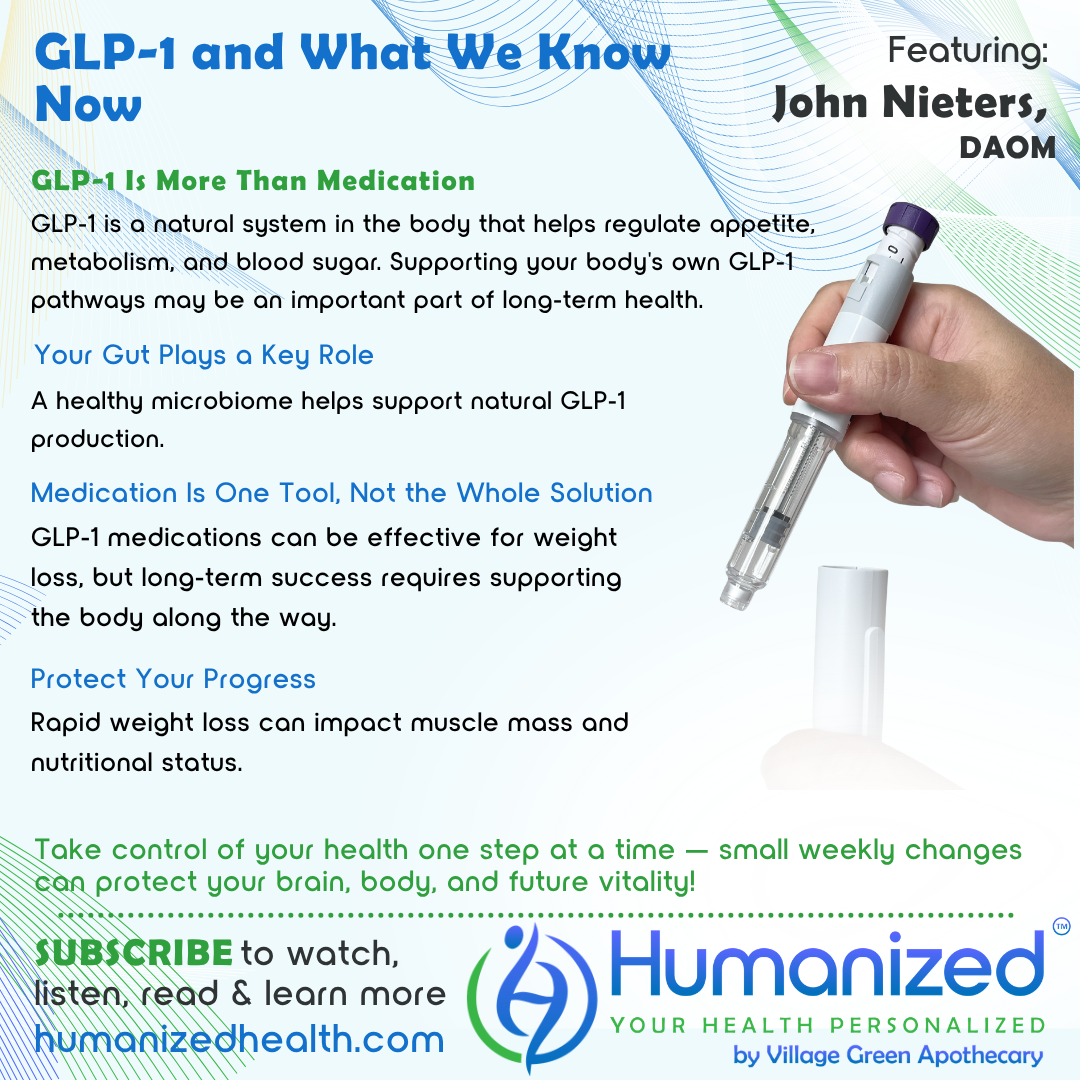
GLP-1 and What We Know Now
Featuring
Dr. John Nieters, L.Ac, DAOM


WATCH
LISTEN
READ
Dave Stouder: Welcome everyone to the Humanized Health Podcast, where we really want to help you personalize your approach to health. I’m your fill in host today, Dave Stouder, and we’re gonna be discussing GLP-1. What we know now. And GLP-1 is something natural in the body. It’s not just medication. It’s something we could be making on our own and maybe we don’t. And so we’re here with Dr. John Nieters. This is his second time on the podcast. He’s an old friend of mine. And what I’ve always [said], as way of introduction, John is an acupuncturist, a Doctor of Chinese medicine and oriental medicine, but he’s the most, here’s an adjective for you, John, deeply eclectic.
John Nieters: That’s one of the nicer things I’ve been called.
Dave Stouder: Yeah. John – ’cause I’ve been a patient and done radio with him – John is just, not to embarrass you, I find him amazing that he’s dug in so deep to acupuncture, but also to western herbalism and also to diet, and he does functional tests and regular medical tests and knows about surgeries and medications. I can almost know that if I ask John any health-related question, he’s gonna have something that I’m gonna learn. Sometimes it’s quite a bit, but he’s just always been amazing. I’m really glad to have him on the show because as we talked about in our last podcast, by really having a big tool chest, as you said, rather than just “I have a hammer, everything looks like a nail.” John really does a fantastic job of meeting people where they are, putting all those things together and creating health. Now, I’ve been thinking about this GLP-1 thing. Okay. And I wanna share my perspective and your thoughts on it, correct me if I’m wrong or we’ll go somewhere.
If people have blood sugar problems or they’re overweight, there’s a lot of factors that would contribute to that. It seems like advice always starts with don’t eat so many sweets and carbs, change your diet and exercise. You know that would be the two things to start with and obviously there’s other reasons, but I know a lot of people who do that don’t get any results and I was looking at some research and it seems like we’re about as sedentary as we’ve been the last 25 years, hasn’t changed a lot. And we might even eat as a people a little less carbs than we used to, but not a lot.
That hasn’t changed, but obesity and diabetes have gone way up, and I think a lot of it is metabolic disruption. From a variety of things, toxins. So, besides the fact that maybe we eat too many carbs, we’re not exercising, there are a lot of people that change the diet and don’t get results, and there are a lot of people that do all the wrong things and stay pretty slender.
And so we have a natural GLP-1 system in our body. My understanding is the microbiome digests beta glucans and fibers, and makes, I think, short chain fatty acids, which make L cells, which can make GLP 1, 2, 3.
John Nieters: Wow. Impressive. Pretty impressive.
Dave Stouder: Okay and if people are having trouble, I think there are things we can do naturally to renew and bring that back. On the other hand, I know that GLP-1 has to be the metabolic disruption point because when you take the drug, as far as losing weight, it works. Now there are some downsides. Many people get some pretty serious downsides with GLP-1. A lot of people, not so much. But the first thing, so I’d like to ask you, I’m assuming you see people who either sort of wanna know about GLP-1, but are nervous about the medication, and I’m sure you have patients that are on the medication. My first question would be jumping off from what I just said. If I come in and say, “John, I need to lose weight. My friends are taking GLP-1, but I’m nervous about it.” What sort of advice would you give me? And I realize it’s a big topic, so we would probably be talking for an hour if I was your patient, but to really focus in – to help my GLP-1 without medications. What are just some of the key points you could offer us?
John Nieters: I give out a lot of information to my patients, both in written form and verbally, but I have one study that I really enjoy. It’s about a 28 page paper, a meta-analysis, and essentially what the title is, Inflammation Always, and then it says, almost, starts in the gut, with the microbiome. So if you don’t change that, ultimately, you’re gonna have problems, even if you’re using the GLP drugs, right? And we’ve known for decades that if you. Do a fecal transplant. You take poop from a skinny person and you put it into an obese person, the obese person loses weight. That’s pretty clear proof that the microbiome has a heck of a lot to do with this. And I think that one of the places that, we’re talking about diet, et cetera, it’s what is going to create a healthy microbiome? That’s a huge piece of it, right? Resistant starches, for example, we’d start a patient with. Potatoes got a big, really bad rap. There’s some foods that got really bad rap, eggs, potatoes, et cetera, and some that got too good a rap, chicken, right? But potatoes have a very high amount of resistant starch. And so what that means is, it doesn’t digest completely in your small intestines. Some of it does and gets released as blood sugar, but most of it is resistant, so it gets to your large intestine where it feeds the good bugs, the good bacteria, which then start releasing all the chemicals that you need into the gut to heal the gut. And so in fact, if you take a baked potato, for example, very high potassium levels, I give a lot of people that recipe when they have low potassium, it’s about a gram. And, I’ll tell ’em, bake up a bunch of baked potatoes. Put a most of in your refrigerator, eat one or two, put ’em in your refrigerator, and that creates even more resistant starch.
And that’s really well proven. And so you can pull that out. It’s filling. It doesn’t release a lot of sugars into your system. In fact, Dave, I gotta tell you a quick story. There’s a president, I think it was Washington State, but it might have been Idaho State Potato Growers Association. So he goes to his doctor, and his doctor said, “Oh my God, look at your blood sugars and your cholesterol. Everything’s bad. You’ve been eating too much of your product.” So the guy went home, he was really angry and all he ate for a month was potatoes, that’s it. Nothing but potatoes. He went back to the doctor and the doctor said, “Oh my God, I just got your new labs in. Look at this. You must have followed my diet, ’cause your blood sugars are better, your cholesterol is better.” And then the guy told him, right? And so the microbiome is really the key. And your microbiome creates GLP-1s, natural GLP-1s. Now we will have people, there’s a product that was released a little while ago that was funded by the New Zealand government to the tune of about $30 million over 14 years, and they were looking for the most bitter substance they could find because they knew that caused GLP-1 release. We’ve had people doing bitters for years, either, the Swedish Bitters or eating an arugula salad, something like that, because that triggers that same GLP-1 response. So anyway, in New Zealand, they did tons of research and they found that growing in New Zealand was a particular type of hops that was the most bitter food they could find, and they found a way to encapsulate it so that you don’t taste the bitter. In fact, I made the mistake, Dave, I don’t drink enough fluid, so I sit here with three cups of different things beside me, and I put in one of those capsules and I looked and I didn’t have any water. I said I’ll just finish what I’m doing. Oh my God, I couldn’t imagine anything could be that bitter. So a lot of people, just by cutting things out, that may not be enough, even cutting out carbs because you’ve still got the bad bacteria in there, right? And so you’ve got to change that microbiome. And again, bitters, resistant starches, things like that. I love, there’s the certain new fiber products that are being released that are just amazing. They even have resistant starch in them, and I find if people will do that, and again, as you gotta get to the root of this. I had a friend, and I used to go out to dinner with her and she ate much less than I did. She exercised a lot and she was morbidly obese. And every time she’d go in, her doctor would say you’re lying to me. I know you’re eating a lot more than you say you are and you’re not exercising. She was doing all the right things, that she thought were right, at least. But she had eaten so badly for so many years before and had so much stress, her microbiome had become imbalanced. And so, that’s why I know, you’ve got some products that I absolutely love that we get from you because they have pre, post, and probiotics, and you gotta have all of those. You just put probiotics in there and the terrain is destroyed, they’re not gonna grow. So you need to really restore the function of the gut. And so that’s where we start.
Now, I shocked one guy. He did a telehealth and he had his naturopath girlfriend, or I guess she was a PA, with him. And, he said, “Now I know how you’re gonna respond to this, John. I know that it’s okay, but what would be the fastest, best way for me to lose weight?” And I said Tirzepatide and he almost fell off of his chair. The woman with him just started clapping, “See, I told you that was right.” ‘Cause I knew that’s what she wanted. And fast? Yeah, it’s fast. And honestly, we haven’t seen a lot of problems with Tirzepatide until people start trying to get off of it, and then they get some rebound because it’s burned up. It releases so much more GLP than the body does naturally. And so it’s a little tricky. It’s ’cause it’s a combination. GLP and GYP , where things like Wegovy are singular. If the dosage is too high, we’ve had people get hospitalized, it will completely paralyze the stomach and they’ll get the vomiting syndrome, et cetera. So you gotta be really careful with it. If you’re going to do those, and I have a lot of patients that are, you gotta start low and slow. But while you’re doing it, you still want to fix the microbiome so that when it’s time to come off of those, you’re set so that your gut can really rebalance itself. So I’m not against them. I think they’re overused.
Dave Stouder: I hear that they’re finding out that a lot of these medications seem to degrade muscle. And so they’re recommending higher protein diets.
John Nieters: Higher protein, and the better centers that are doing that work with the GLP will put people on a very strict exercise regimen. ‘Cause you know you’re losing weight, it’s easier to lose muscle mass than it is to lose fat, actually. And so they start giving frail actually. So yeah, they’ll put ’em on a, a higher protein diet and give them very specific exercise routines. And then they’ll measure them.
They’ll put ’em on an inexpensive DEXA and see how much muscle mass they have.
Dave Stouder: So in a sense your general advice to people listening who are doing these medications is, you still have to do the right thing, because you don’t have to wait for your system to normalize, to start making your own GLP-1, which could take a while. Some people it could happen fairly fast, I think. But you still wanna really pay attention to your diet and exercise, and this will minimize your chance of a problem.
John Nieters: Absolutely. And I will put most people that are going through that, I will have them do some, other supplements. Creatine, for example, which has been shown to actually support muscle mass, even in the absence of exercise. Now, if you exercise, it’s better, obviously, but, so I’ll put ’em on something like that. It might be creatine, it might be something else. It might be a Chinese herbal formula to help support their muscles from degrading.
Dave Stouder: Yeah, because I want people to be safe. I know someone in my family who lost 40 pounds, but ended up with female complications and had the uterus removed. And yeah, I know a lot of my friends had the uterus removed. And I’m like, eh. I think it’s a coincidence, but I just want people to be safe. And like you said, the drugs work. I haven’t met anybody who said I took GLP-1 and nothing happened.
John Nieters: I have.
Dave Stouder: I’m sure. It seems pretty consistent, but I think it’s so important what you say, it’s that working with your microbiome and working with your diet is still gonna help maybe mitigate a lot of the negative effects, and then eventually you can get off. Because one of the things we always used to talk about, John, is that drugs don’t have side effects. they have effects. And I stopped drinking a few years ago, but if I start drinking a whole lot one day, my liver will speak to me, and that’s not a side effect of alcohol. That’s an effect, right? Some people can get pretty sick in a month. Some people can go 10 years.
John Nieters: We had talked about AI in the last show, and what I see as a great use of AI for me is when someone is on several drugs, they’re on Finasteride and Metformin, et cetera. I used to have to pull out a textbook or sometimes I knew off the top, but I’d have to look, pull things out and research it and see what vitamins and minerals it was destroying. And now, one of my companies has a really easily searchable AI, right? I plug in metformin, “Oh, no wonder these labs are off.” Or I put in Finasteride, which I did the other day, and you can see depletions in certain things. And so that’s really handy to have. So that’s a good use of AI, I think.
Dave Stouder: Yeah I think research is a good use of AI. Not so sure if it really does any thinking or if it just is a much more targeted search engine than say Google.
John, I appreciate you taking your time and I think maybe you’ve given people some good advice that, it appears that many people could get their GLP-1 in gear without medications if they want to. But they should take precautions if they are on the medication. Because, I met people, if you’re really obese and [for] a long time, just frustrated, it’s so nice to say, “hey, two months later I lost 50 pounds.” And that’s very encouraging and hopefully it just encourages people to go, “If I do something different, I can keep this off.”
John, how do people get in touch with you? Because you have a clinic in Alameda, California, and also you put out a lot of information and podcasts. So if people wanna look deeper into what you’re doing how can they do that?
John Nieters: On the clinical side, they could go to alamedaacupuncture.com, and on the, I’m gonna call it, research side, podcasts, articles, et cetera. They can go to thebalancingpoint.net. There’s way too much information on there.
Dave Stouder: Okay. So take it easy on that. And remember, you can go to humanizedhealth.com and see our other interviews, including one with Dr. John Nieters and we encourage you to do that. And again, we want to thank Village Green Apothecary, who’s the main sponsor of the Humanized Health Podcast. Appreciate that.
John, again, thanks for that insight. We appreciate it and we’ll have you back soon.
John Nieters: Dave, it’s been an honor and a lot of fun. Thank you.
Dave Stouder: Yeah. It’s nice doing interviews with you again as we used to do that. So take care, John.
John Nieters: Alright, thanks Dave.
 Download Pdf