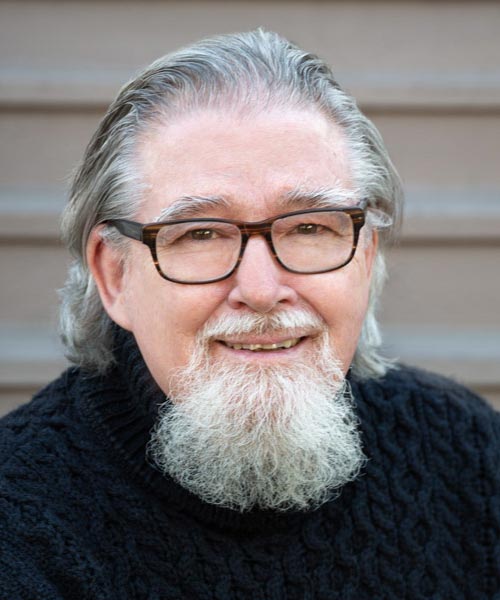
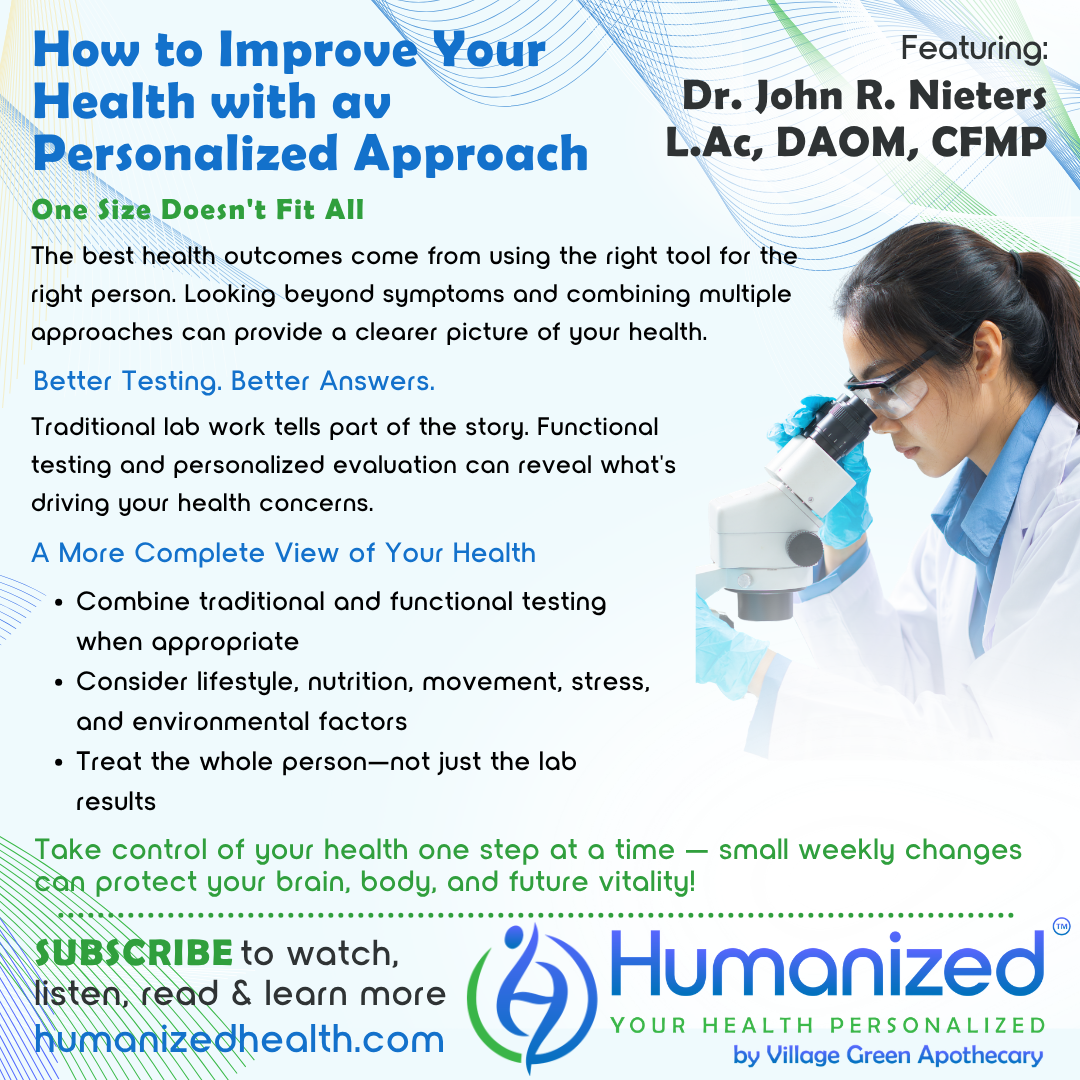
How to Better Your Health Outcome Using Diverse Approaches
Featuring
Dr. John Nieters, L.Ac, DAOM


WATCH
LISTEN
READ
Dave Stouder: Welcome everyone to the Humanized Health Podcast, and it’s all about personalizing your health. I’m your host today, Dave Stouder. And with us, we have a friend of mine and a brilliant practitioner. Not to embarrass you, John, but Dr. John Needers. And we’re gonna talk about How to Better Your Health Outcome Using Diverse Approaches.
And before we do that, I just wanna remind you that you can get all of our podcasts here. You can get video, you can get audio, you can get transcription, and we appreciate you can go to humanizedhealth.com and we appreciate Village Green Apothecary for being the main sponsor of this show.
Now I’ve known John for quite a while, and I’ll tell you what I know about him and I’m gonna let him fill in some. He is a doctor of acupuncture and I have been a patient, and of course he knows how to use needles. He knows about Chinese herbs. He knows how to read the body. But the really amazing thing that I think about John, is that, he is extremely knowledgeable on Western herbs. He’s extremely knowledgeable about supplements.
He stays up on important studies, and he also knows about medications and works with people who are on medications, and that’s one reason why I wanted to have him on the show because I think he really exemplifies. The kind of practitioner that would serve us all Well, and John, is there anything about your credentials or background that you would like to add to this?
John Nieters: Dave, I think that was pretty complete. I’ve studied a very in-depth diabetes course in China and also gynecology. And my doctorate is in Gynecological Endocrinology. So, all about hormones. In fact, I spent about seven or eight years where most of what I did was working with couples for fertility work.
I do a lot less of that now. I have to keep changing what I focus on because, Dave, when I was younger, I used to change professions every five to seven years, and now I really like this one. It’s perfect for me. It’s an absolute perfect fit. So I just change what I emphasize every five to seven years.
So now we’re doing a lot of work on brain health, preventing Alzheimer’s, preventing stroke, cardiovascular things. I think you did a very good job. Thank you.
Dave Stouder: And I do wanna mention – John is the guiding force behind Alameda Acupuncture Clinic, and that is in Alameda, California. And before the podcast is over, we’ll let John give out his website. He also hosts his own podcast called The Balancing Point. Before we end this podcast, we’ll make sure that you have whatever information, if you’d like to check what John is doing. I wanted to have John on because I knew a very, I don’t need to mention his name, but I knew a very famous acupuncturist in the industry, really good guy and he was very strident about – you use diet and you use herbs. That’s it. He didn’t really wanna hear about medications, about supplements and things like that. And I always thought it was, I don’t know, a little limiting. I’ve always thought you have to meet people where you were.
So John and I used to a radio show together called The Medicine Man. And I always tell this story that, our typical prep for the show was while we were waiting to go on the air. “Hey John, I got some really good questions for you today”. And he’d say, “okay”. And I always found that John pretty much knew, at least something interesting about everything. I wanna ask you, John, since you are, a doctor of acupuncture, what sort of moved you into being more eclectic, to really broadening your knowledge and your tools into things that a lot of acupuncturists don’t do, as I mentioned like western herbs, like supplements and even not prescribing, but using blood tests and knowing about medications?
John Nieters: Dave, that’s a great question. So when I was in school doing my master’s program, and I’m an old guy, and the way most people my age got into the profession or went into the school is because we had health problems that weren’t being handled by traditional Western medicine and we went to an acupuncturist or an herbalist. And we got cured. So we became convinced and sometimes we became a little overzealous. That’s where I was when I graduated from my master’s program. It’s the five branches of Chinese medicine and primarily pushing acupuncture and herbal medicine toward the forefront, but doing the other branches, also diet, et cetera.
Then, just about the time I was graduating, let’s see, it was actually in 1999, a person that I knew said, “Hey, come with me to this workshop this weekend.” And I said, “Why?” And she goes, “It’s on leaky gut.” Now you gotta remember, this is 1999. Nobody was talking about leaky gut at that point. And I said, “Why would I do that? I’ve got all the tools I need.” And she said, “Oh, come on, please do me a favor and come with me.” She was my study partner for the state exam, so I figured I’d better, and she did most of the work, so I figured I’d better go along. Dave, within an hour, no kidding, within one hour, my brain felt like it was gonna explode.
The guy that was teaching the course, a brilliant Doctor, Jake Fratkin, been around forever. He’s won every award you can win in Chinese medicine and Oriental Medicine, and he was teaching this leaky gut class and he started introducing the microbiome, which is not what it was called at that time, but that’s what we would call it now, and the gut integrity issues and why our culture had become so out of balance, unable to process, to absorb nutrients, and, really, absorbing a lot of poisons that were leaking into our system from leaky gut. Within an hour, it was like, oh my God, this is like a hand in a glove! We’re just looking at exactly the same purpose, but a different orientation.
I was looking through a window on one side, and then I could run around and look through a window on the other side and get a different view of the lay of the land. And so, that just blew me away, and that’s what started my journey into functional medicine. At that time there were not a lot of labs that were doing functional tests. I think there were a couple companies that I used for stool testing and one that I used for hormone testing, et cetera. Not much. Now there are hundreds of tests we have to choose from. So, if I wanna test someone’s gut and their microbiome, we actually have a big TV that we can screen share on, and we’ll put five or more tests side by side and scroll through them to see which one is the best fit for our patients.
So everything, urine tests have changed dramatically. Now, we have dried urine testing, which is amazing for testing hormones and adrenals, right? And so once I saw that fit, I became like a man possessed. I studied everything I could about functional medicine. Which, at that time, there wasn’t a lot. Now there is a lot. I get dozens of podcasts every day and different sites to look at, blogs, and to me it’s really about, humanizing, as you mentioned, and it’s about using the best tool for the job at hand. There’s an old saying, if you’re a hammer, everything looks like a nail, right? I wanted to have a full toolkit, right? And so, I love western medicine mostly for their imaging. I love western medical imaging. I’ve gotta think if these ancient Chinese had it available to do an MRI, they would’ve probably done it. So I think that’s beautiful. Surgical techniques are advancing so fast.
I see new surgical techniques or anything you can think of just on almost a daily basis. It’s magical. However, they aren’t good at keeping people healthy. They’re good if you’ve got an emergency, right? Or if you’ve got some very, very serious problem sometimes you will need that. And I’m, people think I’m anti-drug. I’m not anti-drug. I just think they’re grossly overused and often for too long a period. Like if someone comes to me with high blood pressure, a really high blood pressure, or I check ’em and I find their blood pressure’s 190 over 100. I’m gonna sit down with them while they call their medical doctor, so they can get a pharmaceutical to knock it down fast.
But then, we’re gonna work on lifestyle, supplements, herbs, exercise, so that they can start getting it down even lower. And when they get to a certain point, they can go back to their medical doctor and get off the medication. And to me, that’s how those medications work the best. Someone has high blood sugar, diabetic… diabetes is reversible. Juvenile onset, not so much, but type two. And you just have to really go about it the right way. MDs generally don’t, they’ll throw out a few words about, oh, “change your diet, get some exercise,” but it’s a throwaway, where we go into tremendous detail about specifically what we want you to do in terms of diet and exercise, even relaxation techniques, et cetera. But anyway, I love western medicine for those things. Surgery for emergency use of drugs, emergency treatments.
I love functional medicine because the number of labs that are available that Western doctors rarely run; it’s astonishing! As I mentioned, blood tests, urine tests, way more advanced tests to test. We did a podcast recently, and it was titled, Predicting Female Heart Attacks 30 years in Advance. I took that title because there was a research study that was titled that, and you need to test for three things. The total cost if we run those tests is $38, and I found that almost no doctors were running more than one of those and focusing on just a very narrow piece. And so, by using functional medical testing and really western medical testing, we can track so much. Catherine and I have a couple books out, one’s called The Sweet Spot and the other’s The Sweet Spot Too, T-O-O. In those books, Catherine put together all the boilerplate, like ones on the complete blood count, there are 14 tests there, and then on a chem 14, which is also 14 tests, and those are as separate books. She went together, put all the boilerplate – What does it look like if you have low calcium? What does it look like if you have high calcium? What does calcium actually do? That kind of stuff. And then I went through hundreds, hundreds of research studies to find the largest, best run studies I could find and find what’s called the sweet spot. So for almost all labs, there’s a U-shaped curve, and if you’re at the very bottom of the curve, that’s where you’re gonna have the lowest mortality and the greatest longevity.
Now, if you go either way. Higher or lower, you’ll have less longevity and higher mortality risk. So, we went through and looked at hundreds of studies to find what the real sweet spot was for those labs, for people that wanna stay healthy or become healthier. So those tests were all done by large research organizations, but doctors aren’t treating patients based on them.
Dave Stouder: And that’s the other thing that I’d like you to address. Even sometimes with functional medicine and certainly with Western medicine, we go, “Alright, John, I did your labs here and this is outta whack. So take this drug, right? And basically, I could be sitting in the chair, you could be sitting in the chair and that lab would give us both the same drugs. And even in functional medicine sometimes, oh, you need some B one…. but it seems to me that because you’re a functional practitioner and acupuncturist, when you’re looking at someone, you’re taking their pulses, you’re listening to their voice, you’re seeing all these things. I would say almost everything going on inside your body is expressing itself on the outside somewhere, if you know what to look for. And so yeah, what you’re able to do, I think, is you can look at those numbers, which are valuable, but it’s the fact that you’re an acupuncturist, that you can also read the body, and when you put those together, you get a lot clearer picture.
John Nieters: Absolutely. If I have someone come in with POTS, they stand up and they get dizzy, orthostatic hypotension, and their heart rate goes up. And so I can tell that’s gonna be the case from feeling their pulses. ‘Cause there’s a difference quality in the pulses. You can feel the lack of blood volume. You can feel certain differences in the strength. So I’ll know that before I even take them in to do our actual testing where we take a blood pressure in multiple positions, but it’s obvious in the pulses. I did a podcast a while back on bedside diagnosis and I showed looking at someone’s hands, there are eight to 10, depending on how you count them up, signs that can tell you if there’s a likely heart infection or if they’re throwing blood clots. I’ve never had my doctor look at my hands, ever. Never. I’ve never had ’em feel my pulse. And so these are things that are just supporting. It gives me a huge, not even a tool bag, it gives me a huge tool chest to draw from with my diagnostics.
And it’s interesting you said that about, sometimes functional medicine doctors will just give a B1, B2, whatever. We did a test on a woman this morning. It’s called an Oligo scan, and it actually is the only reasonably priced test that actually measures intracellular heavy metals, healthy metals and vitamins
Dave Stouder: Rather than a serum, rather than blood.
John Nieters: Yeah. Because when you do a serum test, that’s fine. It’s testing for lots of great stuff, but it’s only measuring what’s not in your cells. Same with the urine test. It’s measuring what’s not in your cells. A hair test, it’s not in your cells particularly.
And so this is measuring what’s in your cells and we gave a seven page report to this woman explaining why her vitamin D is so low, when she takes massive amounts of vitamin D, right? And her serum level’s high, but she has all the earmarks of having low vitamin D, and it explains what the biochemistry is that’s happening and what precursor minerals you need so that you can get that back in balance. If you just throw more vitamin D at it, it’s gonna make the problem worse in some cases. And you’re looking at things like zinc to copper ratios. All these things that are so critical and generally overlooked, and we take a lot of pride and a lot of time with our patients so we can humanize them, right? You want to treat the person, I talked to a European doctor, and he said the difference between us is that doctors in Europe treat people and doctors in the US treat lab results. And I thought, but it’s true. They didn’t even have to look at their patients.
Dave Stouder: I’m thinking that, probably AI in a computer just, put your blood in somewhere, let somebody test it, and they’ll spit out the medications and or supplements you need. And I’ve just always been impressed at your ability, where you can really get an individual idea by, by looking at functional tests, looking at traditional medical tests and doing the sort of examining of the actual person, which is quite complex. I’m aware of that and I want, just wanted to say to people, if you’re not familiar, every organ has a pulse. When John was talking about pulses, he’s not just talking about the heart. You can feel a liver pulse and a kidney pulse and all those, and it’s really remarkable. John, I really wanna thank you for all this and one of the things I’d like people to take away from this is you really should get somebody on your side that can do functional medicine and help you in a natural way because you know what? You don’t want to go finding somebody in a crisis, okay? This is your time. Now go find a nutritionist. Go find a functional doctor, an MD, somebody that you like and someone that works for you so that if a crisis arises, you have someone that you’re working with. John, if people wanna know more about you or get in touch with you what’s your website? How do we find you?
John Nieters: Our website for the clinic is alamedaacupuncture.com. And that’s to find out about our clinic and our practitioners, et cetera. The educational site is thebalancingpoint.net. And on there we’ve got just so much information. We put out one to two podcasts a week. We try to stay timely and relevant, I don’t care who you are or how bright you are, you have to keep learning ’cause there’s new stuff that’s coming out every single day. Every day.
Dave Stouder: Every day. I’ve often said once you start thinking like you’re really smart and you know everything, that’s the first sign that you’re getting stupid.
John Nieters: I once had someone tell me, if you go into a doctor’s office and he doesn’t have a bookshelf, leave. One thing, you mentioned AI and I’ll have a lot of patients that come in now having gotten a conference with ChatGPT or some other source, and they’ll say, I decided to take these things, and I said, okay. That’s good information. It’s good content, but what you need is context, right? I’ve seen over 70,000 patients and that helps me create context, it’s very different. And sometimes, the combinations they’re seeing aren’t really right for their condition, right? And so it’s important to know that.
Dave Stouder: And this podcast is trying to promote the idea of really humanizing medicine in the broadest sense. And I think you do a great job and I appreciate you being on the show today. And remember that you can find John at alamedaacupuncture.com and thebalancingpoint.net and so, we appreciate your insights to this. I’d like to have you back soon. I’d like to have you talk about GLP-1. There’s some new things we’re learning. It’s certainly a hot topic. So John, thank you for being on the Humanized Health Podcast.
John Nieters: Dave, this brought back so many great old memories. Thank you.
Dave Stouder: Take care.
 Download Pdf